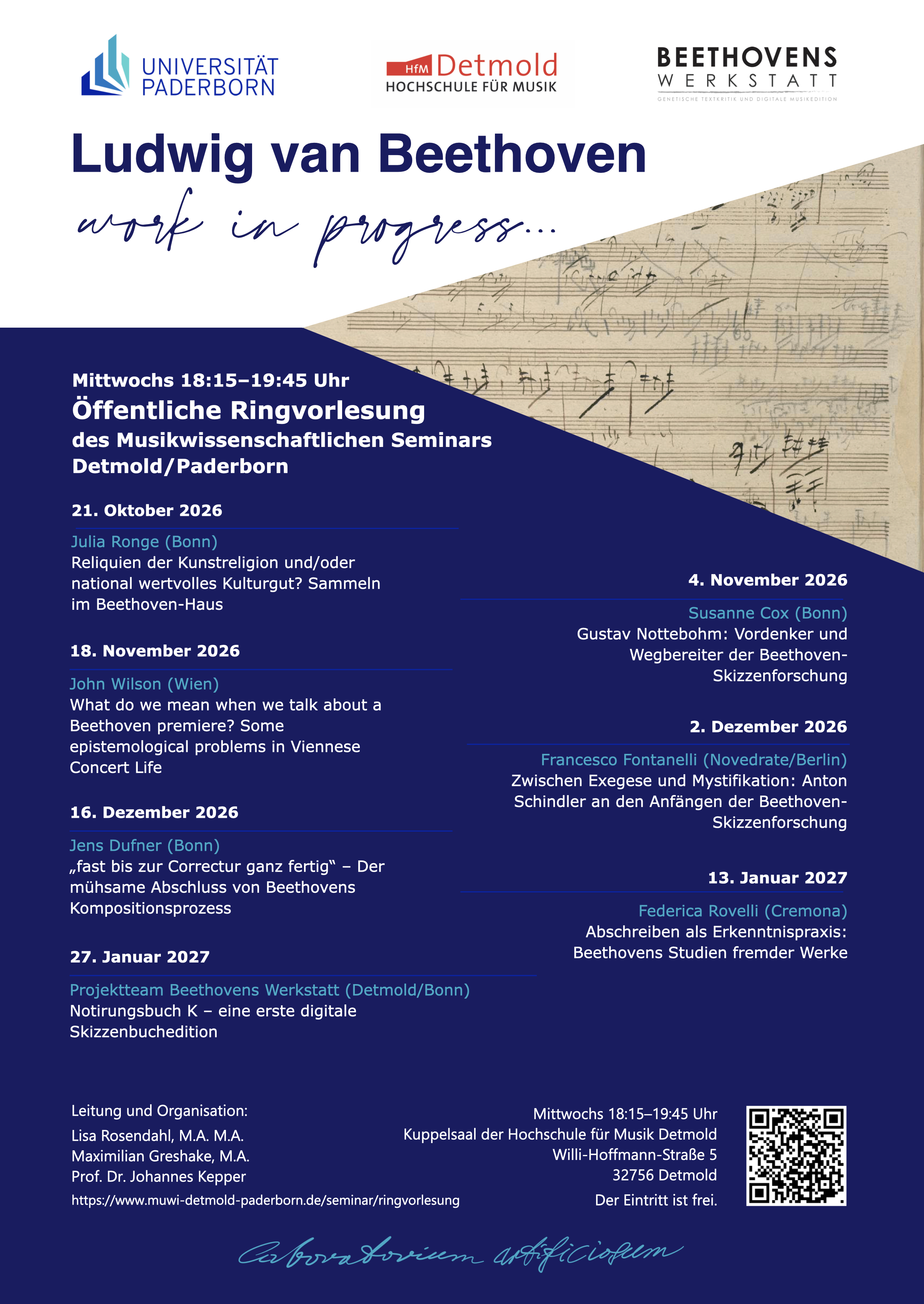
Vienna’s musical life in the decades around 1800 was as vibrant as it was loosely defined. Professional and amateur performers alike gathered in drawing rooms, cafés, representative halls, and theaters to play, sing, and listen to music. For the music historian, the very nature of concert culture presents multiple difficulties in documentation and interpretation: besides the vagaries of naming conventions at this early stage of music journalism, even the notions of what constituted a concert, of public and private, and of the boundaries between audience and players, were all conceptualized in different ways from today. The digital medium however offers many advantages in studying and communicating concert data from this era. In this talk, a presentation of the new web database “Concert Life in Vienna” (viennaconcertlife.univie.ac.at) will serve as a launching point for discussing the ontological challenges associated with and best practices for bringing historical concert data into the digital realm.
Among these challenges is the way in which we discuss and categorize first performances of Beethoven’s music. Since private concerts were seldom really private, and public performances were as a rule only nominally more open to a broader audience, our research suggests a more flexible definition and softer divisions between these categories.
John D. Wilson, PhD, studied piano, composition, and musicology at Baylor University and the Universität für Musik und Darstellende Kunst Wien (mdw). The Principal Investigator the research project “Musical Life in Vienna 1780–1830” at the Austrian Academy of Sciences, Wilson’s research focuses on eighteenth- and nineteenth-century music, with a special emphasis on Beethoven and his contemporary contexts. His many publications on this composer include an extensive biographical article for Grove Music Online, the edited volume Beethoven in Context, and Oxford Bibliographies.
Rooted in his background as a pianist, Wilson is passionate about the role that music research plays in public life and maintains a diverse profile of activities outside academia: in music editions, program and CD notes, museum exhibits, and public lectures. He has appeared in documentaries on the BBC and ORF. His ongoing work with Dirk Kaftan and the Beethoven-Orchester Bonn has resulted in a multi-year concert series and award winning recordings. His first editions of the early orchestral music of Antoine Reicha, published by Ries & Erler and recorded by the Munich Radio Symphony, have helped fuel a resurgence of interest for this fascinating figure.
Deutsche Kurzbiographie:
Dr. John D. Wilson studierte Klavier, Komposition und Musikwissenschaft an der Baylor University und an der Universität für Musik und darstellende Kunst Wien (mdw). Als Leiter des Forschungsprojekts „Musical Life in Vienna 1780–1830“ an der Österreichischen Akademie der Wissenschaften konzentriert sich Wilsons Forschung auf die Musik des 18. und 19. Jahrhunderts, mit besonderem Schwerpunkt auf Beethoven und seinem zeitgenössischen Kontext. Zu seinen vielen Veröffentlichungen über diesen Komponisten zählen ein umfangreicher biografischer Artikel für „Grove Music Online“, der von ihm herausgegebene Sammelband „Beethoven in Context“ sowie Beiträge für die „Oxford Bibliographies“.
Ausgehend von seinem Hintergrund als Pianist engagiert sich Wilson leidenschaftlich für die Rolle, die die Musikforschung im gesellschaftlichen Leben spielt, und ist auch außerhalb der akademischen Welt in vielfältiger Weise tätig: in den Bereichen Musikeditionen, Programm- und CD-Begleittexte, Museumsausstellungen und öffentliche Vorträge. Er war in Dokumentarfilmen der BBC und des ORF zu sehen. Seine fortlaufende Zusammenarbeit mit Dirk Kaftan und dem Beethoven-Orchester Bonn hat zu einer mehrjährigen Konzertreihe und preisgekrönten Aufnahmen geführt. Seine Erstausgaben der frühen Orchesterwerke von Antoine Reicha, die bei Ries & Erler erschienen sind und vom Münchner Rundfunkorchester eingespielt wurden, haben dazu beigetragen, das Interesse an dieser faszinierenden Persönlichkeit wiederzubeleben.